
Monday, March 24, 2014
Viruses
This week in AP Biology we talked about viruses. Viruses are very tiny and there genomes can be double or single stranded DNA or double or single stranded RNA. Viruses have a capsid which is a protein shell that surrounds the genetic material. Some viruses have viral envelopes that surround the capsid and aid the viruses in infecting their hosts. A type of bacteria we studied the most was bacteriophages or phages. They are viruses that infect bacterial cells. Viruses can only replicate in host cells which means they can infect limited variety of hosts. There are two viral reproductions. One is called the Lytic cycle and the other is the Lysogenic cycle. The lytic cycle ends in the death of the host cell by rupturing. Bacteriophages injects its DNA into a host cell and takes over the host cell's machinery to synthesize new copies of the viral DNA. In the lysogenic cycle the bacteriophage's DNA becomes incorporated into the host cell's DNA and is replicated along with the host cell's genome.

Monday, March 10, 2014
Gene Expressin
This week in AP Biology we talked about gene expression. Gene expression is the process by which information from a gene is used in synthesis of a functional gene product. These products are usually proteins.There are three steps to gene expression. The first step is transcription and it is the synthesis of RNA using DNA as a template and also produces mRNA. The second step is RNA processing. The mRNA that was made in transcription goes to RNA processing to yield the final mRNA. The final step is translation. Translation is the production of a polypeptide chain using using the mRNA transcript.

Sunday, March 2, 2014
DNA Replication
This week in AP Biology we talked about DNA replication. DNA replication is the process by which a DNA molecule is copied, and how cells repair their DNA. DNA replication is a very important process in all living things. The replication of a DNA molecule begins in particular sites called origin of replication. Initiation proteins bind to the the origin of replication and separate the two strands which form a replication bubble. Then the DNA moves in both directions of the DNA strand until it is copied. DNA polymerase adds nucelotides to the growing chain working in a 5` to 3` direction. The replication occurs continuously along the 5` to 3` strand, this is called the leading strand and the strand that runs 3` to 5` is copied in segments and it is called the lagging strand. The lagging strand is synthesized in Okazaki fragments which are sealed together by DNA ligase which then forms a continuous DNA strand.

Friday, February 21, 2014
The History of DNA
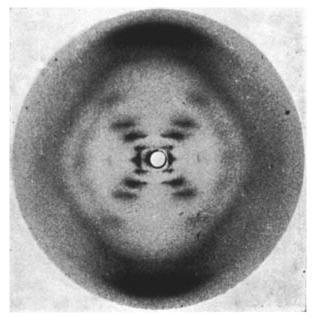
This week in AP Biology we talked about all of the different scientists and other geniuses that proved certain characteristics of DNA. The first was T.H Morgan and he worked with fruit flies and saw that genes are on chromosomes. The second person was Fredeirick Griffith and he worked to try and find a cure for pneumonia. From doing this he saw that harmless live bacteria mixed with heat-killed infectious bacteria caused disease in mice. Griffith called this substance that passed from dead bacteria to live bacteria the transforming factor or transformation. Avery, McCarty, and Macleod also looked for this transforming factor by purifying both DNA and proteins from streptococcus pneumonia bacteria. They found that when they injected protein in bacteria that there was no effect, but when they injected DNA in bacteria, they saw that it transformed harmless bacteria into virulent bacteria. Hershey and Chase, yet more scientist that worked with the transforming factor, but Hershey and Chase confirmed that DNA is the transforming factor by doing the blender experiment. They worked bacteriophage which is a virus that infects bacteria. They grew phage viruses in 2 media radioactively labeled. This blender experiment is how they confirmed that DNA is the transforming factor. Erwin Chargaff saw that all 4 bases of DNA are not in equal amounts. Adenine is 30.9%, Thymine is 29.4%, Guanine is 19.9% and Cytosine is 19.8% of a humans DNA. Watson and Crick simply developed the double helix structure of DNA. A woman named Rosalind Franklin is what gave Watson and Crick to make the double helix structure. And the final two people we discussed is Meselson and Stahl. Meselson and Stahl proved that DNA is semi conservative which is when two strands of DNA separate and one strand is a template and the new strand is laid down. All of these scientist are very important because of their discoveries about DNA.


Sunday, February 16, 2014
Chi Square
This week in AP biology we learned a very important formula called chi square. Chi square is relating to or denoting a statistical method assessing the goodness of fit between observed values and those expected. Chi square as an odd looking formula, (which I will put a picture of at the end of the blog) the odd looking E stands for summation or the sum, the O means what was observed and the regular E means what you expected. If there are multiple observations and expectations, you add each one. For example you have 1600 cards with four suits. You would expect 400 cards of each suit, but when you count the cards, the number is completely random. So you would have to subtract the observed from the expected, then square that number, than divide that number by the expected number, and you will have to continue doing that for each suit of cards and add up each answer to get the final answer. Once you get the final answer, you have to look at your degrees of freedom chart and in our AP Biology class, we look at the .05 chart which means that we are 95% sure. A very important thing to know about the degrees of freedom is that you see how many observation there are and subtract it by one. So if there are 4 observations, you would look at the third degree of freedom. Also if the final answer you got from doing chi square is lower than the degrees of freedom, it accepts the null hypothesis and if its higher, it declines it. The null hypothesis is when there is no significant difference between what is observed and what is observed. Chi square is pretty simple and easy to do once you get the hang of it.


Sunday, February 9, 2014
Genetics (The Basics)
This week in AP Biology we talked about genetics.Genetics is the study of heredity and heredity is a process where a parent passes certain genes to their offspring. The main thing we discussed this week is Mendelian Genetics, which is pretty much mainly focused around punnet squares. Punnet squares are a diagram that predicts the outcome of offspring. For this to work you need the genotype from the father and the mother. A genotype is the genetic makeup of an organism. The genotype in a punnet square are the letters that stand for one or several genotypes in the mother and father. Another thing we talked about were recessive and dominant alleles. Recessive alleles are alleles that are suppressed when a dominant allele is present and a dominant allele is an allele that always shows up unless there is a homozygous recessive allele present. Genetics is a very simple subject to learn about, but it is also extremely interesting to talk about as well.


Sunday, February 2, 2014
Genetics
This week in AP Biology we talked about genetics. In the beginning of the week, we went to a genetics conference at Lubbock. The conference was really interesting! The beginning of the conference wasn't all that interesting, but once we got into cloning, that's when it became extremely interesting. In the conference, scientist have learned that you can take human skin and turn them into stem cells to make a tiny human brain. Another thing that was really interesting at the conference was that scientist are trying to make a thing similar to a fountain of youth. Researchers and scientist are trying to make people who are in their 60's, 70's and so forth, to make them look like how they looked when they were in their 20's or 30's. Scientist are getting closer and closer to be able to clone humans. Since they have cloned goats, horses, and several other animals, they are getting really close to cloning a human. Even though most people and scientists say that it cannot be done because it is to complex, but researchers are figuring out a to make it possible. In my opinion I do not think it is a good idea to clone a human because people can take advantage of this and do crazy bad things. Another thing researches and scientist are trying to do is being able to cure diseases such as Parkinson's, Lou Gherig's Disease. And another thing they are trying to cure is diabetes. All of this is really crazy to think about. Diseases and other issues are starting to become a reality. Like the speaker at the genetics conference Sam Rhine said, science fiction, is more amazing than science fiction.


Subscribe to:
Posts (Atom)